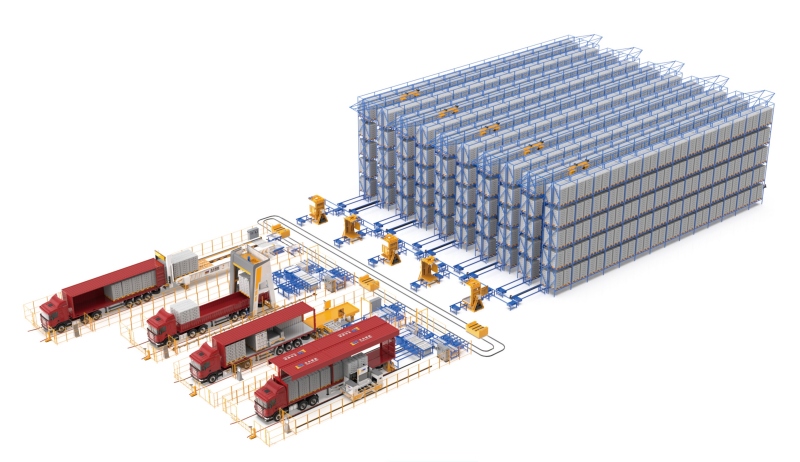
How Intelligent Warehousing Is Transforming Modern Logistics
Jun 30, 2026
As global supply chains become increasingly complex, warehouses are expected to do far more than simply store inventory. Businesses today need faster order fulfillment, higher storage density, real-time inventory visibility, and lower operating costs—all while facing labor shortages and rising customer expectations.
This shift has accelerated the adoption of Intelligent Warehousing, where automation, robotics, and digital management systems work together to create highly efficient logistics operations.
From automated storage and retrieval systems (AS/RS) to AGVs, shuttle systems, robotic palletizers, and warehouse management software, intelligent warehousing is reshaping the future of industrial logistics.
What Is an Intelligent Warehousing System?
An intelligent warehousing system is an integrated solution that combines automated equipment, intelligent control software, and digital information management to optimize every stage of warehouse operations.
Unlike traditional warehouses that rely heavily on manual labor and forklifts, automated warehouses use interconnected systems to manage storage, transportation, picking, sorting, and shipping with minimal human intervention.
Typical components include:
Automated Storage and Retrieval Systems (AS/RS)
High-density racking systems
Shuttle storage systems
AGV and AMR transportation robots
Conveyor systems
ODM OEM Intelligent Warehousing Solution | ASRS, AGV, Shuttle & Warehouse Automation Systems Company - chinaarmysupplier.com
Why Traditional Warehouses Are No Longer Enough
Many warehouses continue to depend on manual operations, but growing order volumes and tighter delivery schedules expose several limitations.
Common challenges include:
Limited storage utilization
High labor dependency
Frequent picking errors
Slow truck loading and unloading
Inventory inaccuracies
Rising operational costs
Difficulty scaling during peak seasons
As businesses expand, these issues directly affect customer satisfaction and profitability.
Warehouse automation addresses these challenges by replacing repetitive manual processes with intelligent equipment capable of operating continuously and consistently.
Robotic palletizing cells
Automatic truck loading equipment
Warehouse Management System (WMS)
Warehouse Control System (WCS)
Together, these technologies create a warehouse that operates with greater speed, accuracy, and scalability.
Core Technologies Behind Smart Warehouses
Automated Storage and Retrieval Systems (AS/RS)
AS/RS solutions maximize vertical storage space while automatically storing and retrieving inventory. High-speed stacker cranes move pallets or storage bins with exceptional precision, reducing retrieval times and improving inventory control.
This technology is widely used in manufacturing plants, distribution centers, and cold storage facilities where storage density is critical.
Shuttle Storage Systems
Shuttle systems use autonomous carriers to transport goods within storage racks, significantly increasing throughput while minimizing travel distance.
Compared with conventional rack storage, shuttle technology offers:
Faster order processing
Better scalability
Higher storage density
Improved warehouse flexibility
These systems are particularly effective for facilities managing thousands of SKUs or handling high-volume outbound shipments.
AGVs and Autonomous Material Handling
Autonomous Guided Vehicles (AGVs) and Autonomous Mobile Robots (AMRs) have become essential components of intelligent logistics.
Instead of relying on forklift operators, AGVs transport materials automatically between production lines, warehouses, and shipping areas.
Key benefits include:
Reduced labor requirements
Improved operational safety
Continuous 24-hour operation
Flexible route planning
Easy integration with manufacturing systems
Intelligent Conveying and Sorting
Conveyor networks and automatic sorting systems ensure products move efficiently throughout the warehouse.
Barcode scanners, RFID readers, and vision systems automatically identify products and direct them to the correct storage or shipping destination.
For e-commerce, retail, and parcel distribution centers, automated sorting significantly increases daily processing capacity while reducing manual errors.
Automated Truck Loading
Warehouse automation does not end at storage.
Automatic truck loading systems connect directly with warehouse conveyors to automate outbound logistics.
Instead of multiple forklift operators loading trucks one pallet at a time, intelligent loading equipment transfers cargo quickly, safely, and consistently.
This helps businesses:
Reduce truck waiting times
Improve shipping efficiency
Lower labor costs
Minimize product damage
ODM OEM Automatic Truck Loading System | Intelligent Unmanned Vehicle Loading Solution Company - chinaarmysupplier.com
ODM OEM Automatic Truck Loading System | Intelligent Warehouse Loading Equipment Manufacturer Company - chinaarmysupplier.com
ODM OEM Rail Guided Truck Loading System | Automated Gantry Loading Solution Company - chinaarmysupplier.com
Intelligent Software Makes the Difference
Automation hardware alone cannot create a smart warehouse.
Warehouse software acts as the brain of the entire operation.
Warehouse Management System (WMS)
The WMS manages inventory locations, order fulfillment, stock rotation, and warehouse operations while maintaining real-time inventory visibility.
Warehouse Control System (WCS)
The WCS coordinates equipment including conveyors, stacker cranes, AGVs, shuttle systems, and robotic workstations.
Together, these systems enable seamless communication between software and automation equipment, allowing the warehouse to respond dynamically to changing workloads.
Industries Benefiting from Intelligent Warehousing
Warehouse automation is no longer limited to large logistics companies.
Today, intelligent warehousing solutions are widely adopted across multiple industries.
Manufacturing
Automates raw material storage and finished goods distribution while supporting lean production.
Food and Beverage
Improves inventory rotation and maintains reliable cold chain operations.
Automotive
Supports high-density storage of spare parts and production components.
Chemical Industry
Reduces manual handling of bagged and packaged products while improving workplace safety.
Pharmaceutical
Ensures accurate inventory tracking and supports strict regulatory compliance.
E-commerce
Processes thousands of daily orders with high picking accuracy and faster shipping.
One Integrated Warehouse Ecosystem
The most successful warehouse projects are not built around a single machine.
Instead, they integrate multiple automation technologies into one connected ecosystem.
A modern intelligent warehouse may include:
AS/RS storage
Shuttle systems
AGVs
Conveyor lines
Robotic palletizing
Automatic truck loading
Intelligent sorting
WMS and WCS software
By allowing these systems to communicate in real time, businesses achieve smoother material flow, greater operational transparency, and higher overall efficiency.
The Future of Warehouse Automation
Emerging technologies such as artificial intelligence, digital twins, industrial IoT, and machine vision are pushing warehouse automation even further.
Future intelligent warehouses will be capable of:
Predicting inventory demand
Automatically optimizing storage locations
Scheduling equipment based on workload
Performing predictive maintenance
Improving energy efficiency
Supporting fully autonomous logistics operations
These innovations will enable companies to respond faster to changing market conditions while maintaining lower operating costs.
Conclusion
Intelligent warehousing is no longer a future concept—it has become a practical solution for businesses seeking greater efficiency, flexibility, and competitiveness.
By integrating automated storage systems, intelligent transport equipment, robotic handling, and warehouse management software, companies can transform traditional warehouses into data-driven logistics centers capable of supporting long-term business growth.
Whether you are planning a new automated warehouse or upgrading an existing facility, investing in intelligent warehousing is an important step toward building a more resilient and efficient supply chain.